Millions of scrap tires are discarded worldwide every year, creating environmental health hazards and long-term pollution. GTG's Rubber Technology line repurposes that waste stream — and explores alternative natural rubber sources — into durable, sustainable materials.
Scrap tire rubber is processed and blended into asphalt pavement, extending road life and cutting the volume of tires headed to landfill.
Asphalt pavement preservation and permanent pothole repair solutions can help private owners, contractors and infrastructure operators reduce maintenance disruption, extend pavement life and improve lifecycle economics.

A domestic, hydroponically-grown alternative to imported natural rubber — a national security and supply chain hedge.
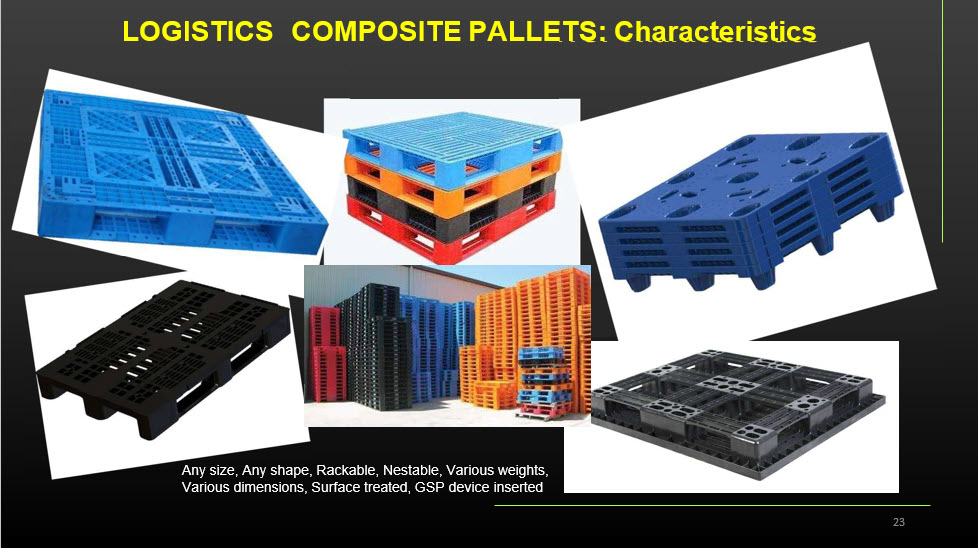
Composite pallets made from recycled tires and plastics — more durable than wood, more repairable than plastic.
A 100%-recycled composite tie engineered for a 50-year service life — roughly 3x a traditional wooden tie.
There are millions of scrap tires discarded each year worldwide, posing environmental health hazards and pollution. Repurposing that rubber into asphalt-rubber pavement gives it a second life as durable road infrastructure.
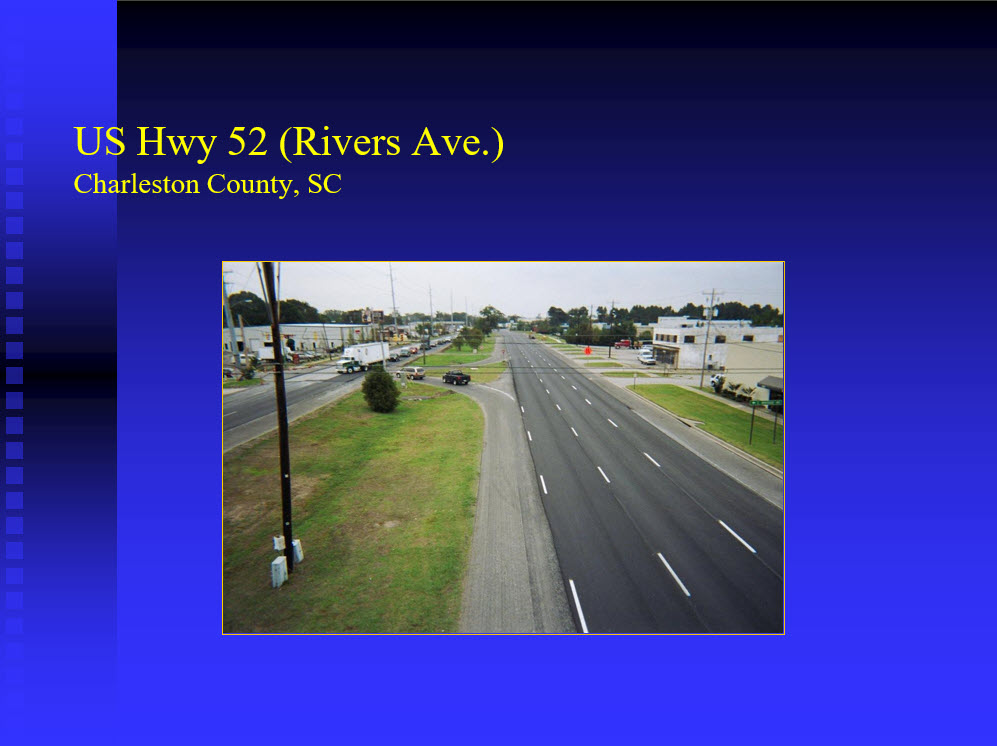
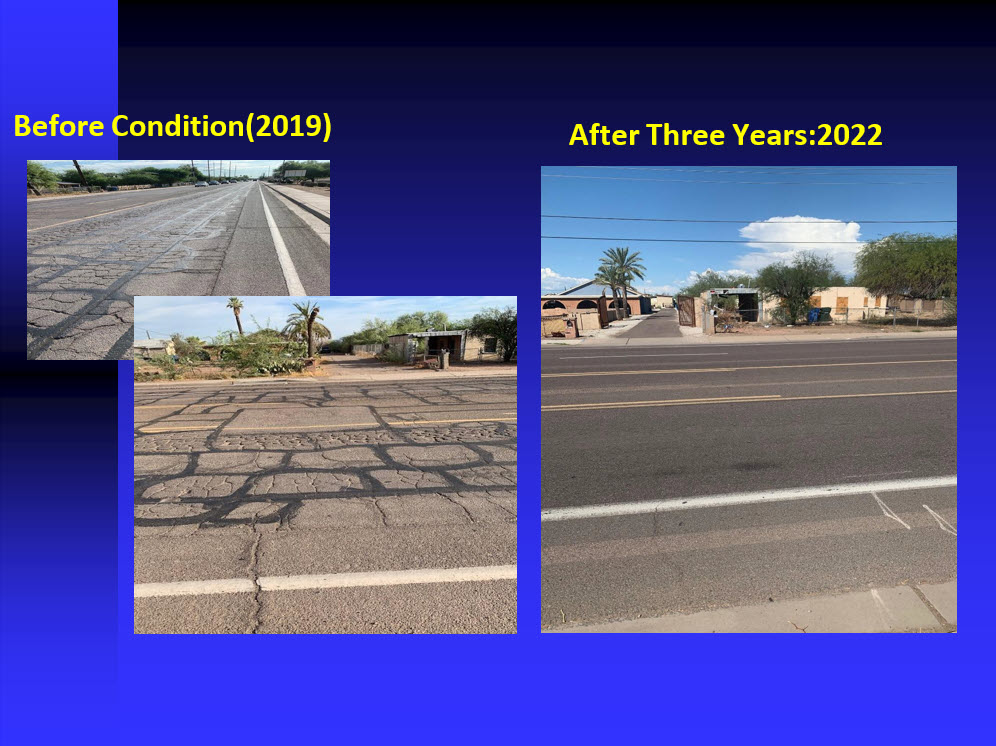
Severely cracked pavement in 2019 restored to a smooth, crack-free surface three years after treatment.

Aggregate is applied over an asphalt-rubber binder layer to create a SAMI — a layer that absorbs stress and slows reflective cracking.
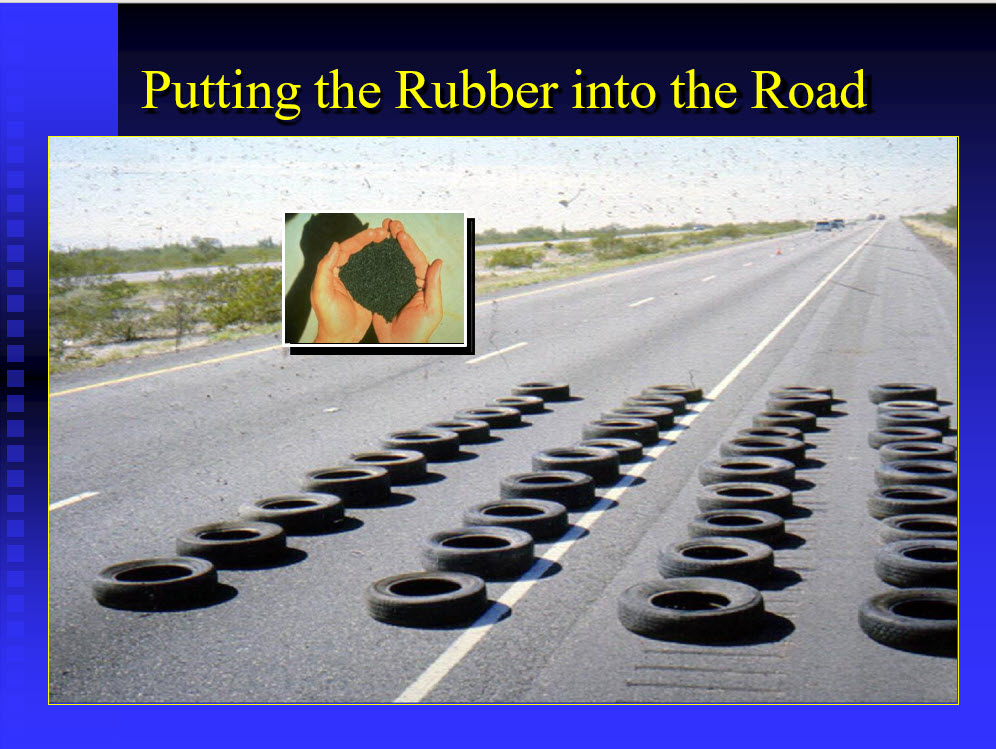
Scrap tires are ground into crumb rubber, then blended into the asphalt binder before paving.
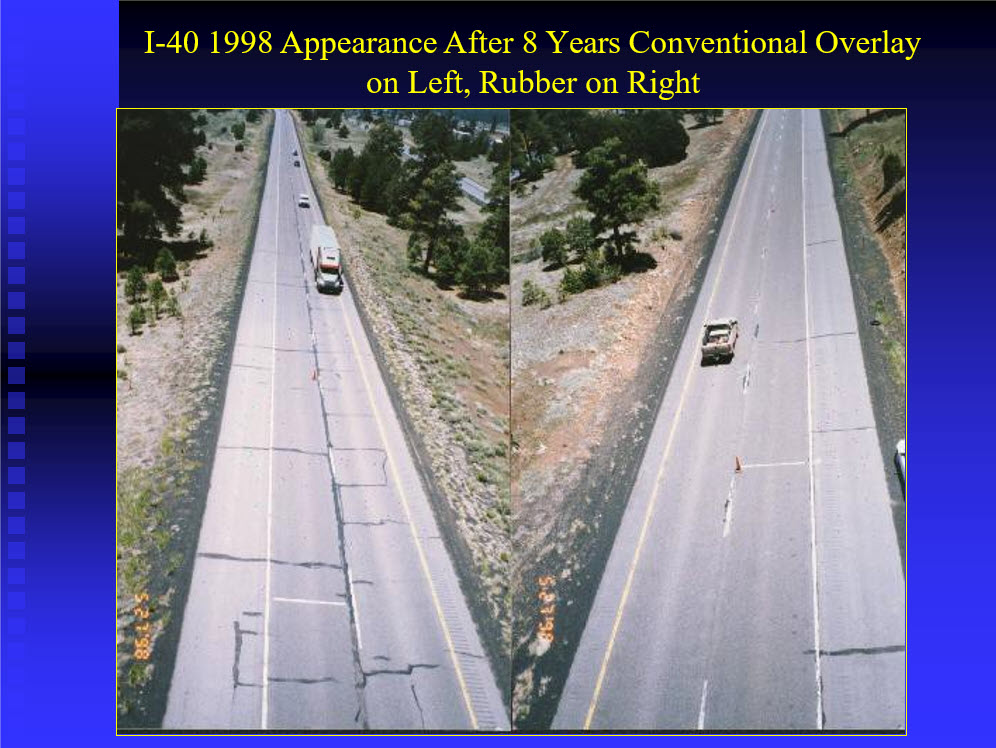
Side-by-side after 8 years: the conventional overlay (left) shows heavy cracking, while the rubberized overlay (right) remains largely intact.
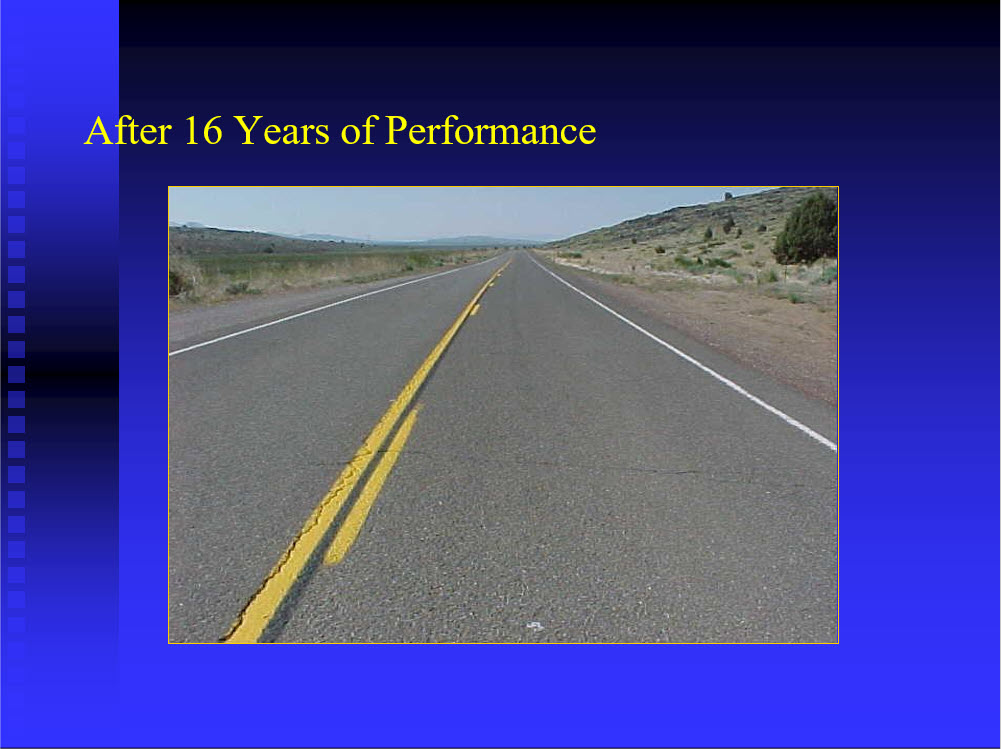
The same rubberized pavement, sixteen years later, still performing with minimal surface distress.
The United States faces a national security risk from its dependence on foreign-grown natural rubber — over 90% of it comes from Southeast Asia. Natural rubber feeds more than 50,000 products beyond tires, including medical supplies and military vehicles and aircraft, so a supply disruption carries real defense and economic consequences.
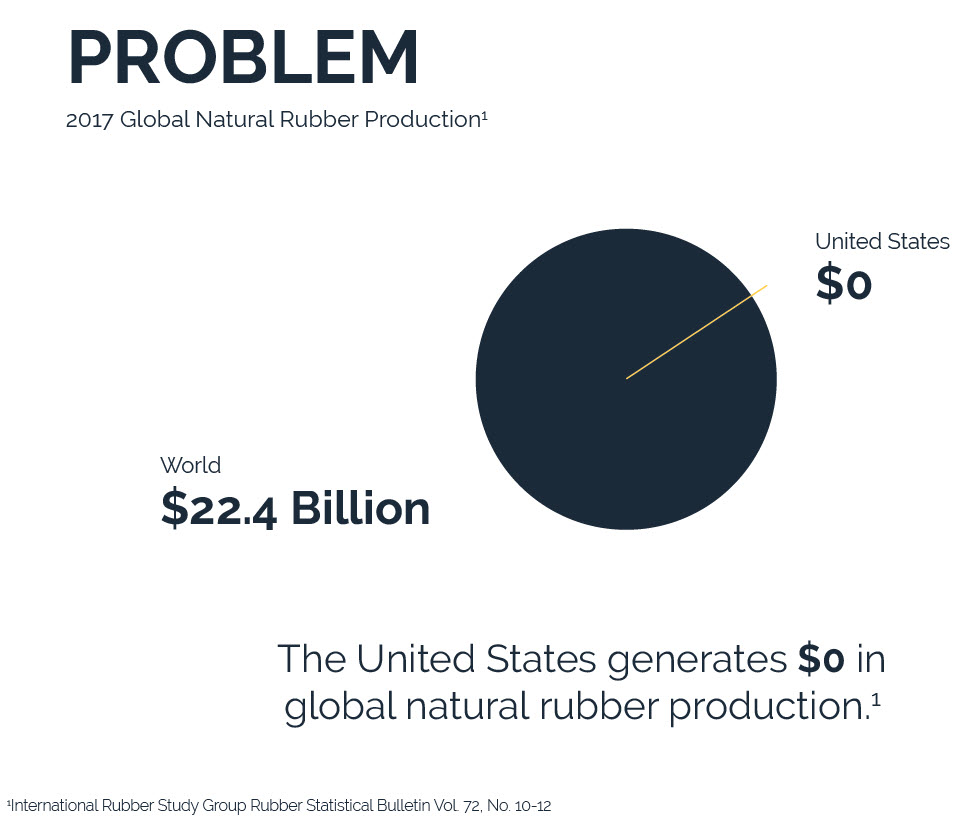
Global natural rubber production was worth $22.4 billion in 2017 — the United States' share of that production was $0.
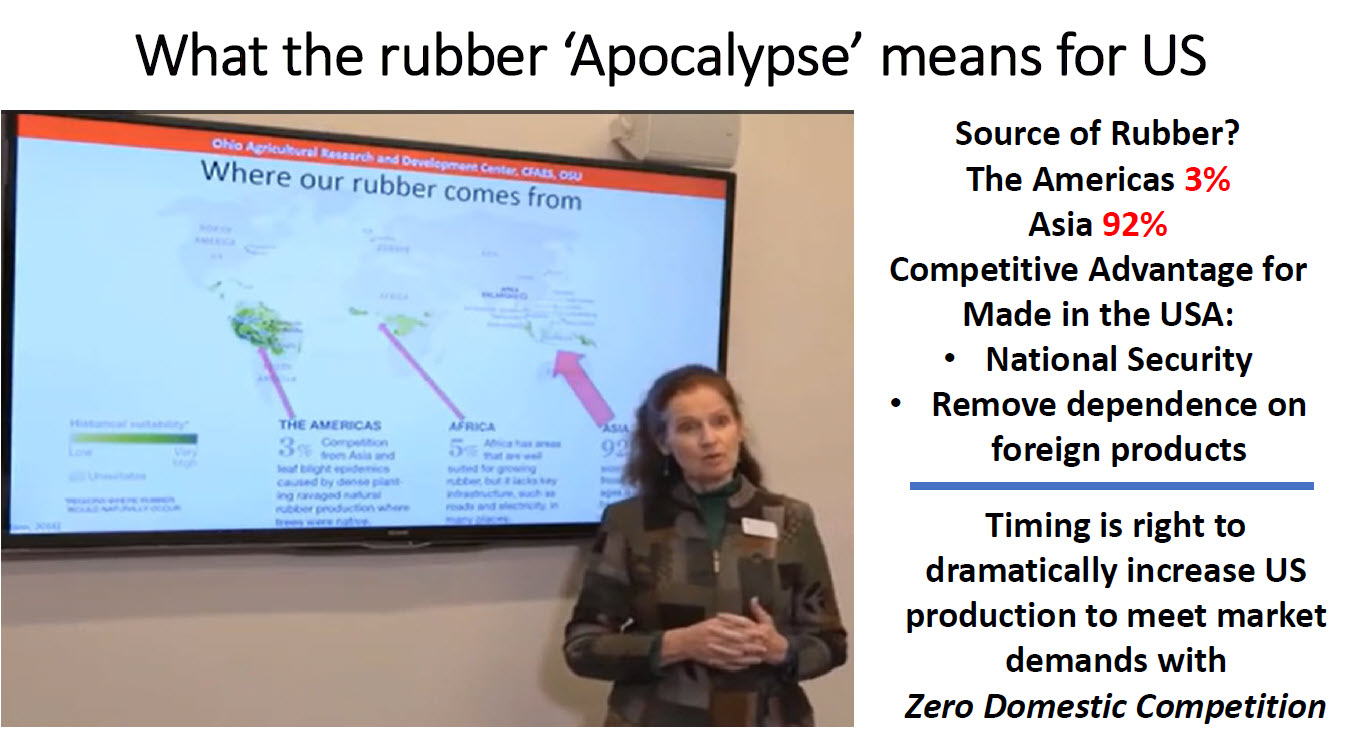
The Americas supply just 3% of natural rubber and Africa 5%, leaving the U.S. with effectively zero domestic competition and a real opening for a made-in-America source.
Nearly all U.S. natural rubber is imported, with no meaningful domestic production to fall back on.
A lack of variety in supplier location creates environmental and political exposure.
Rubber tree crops are susceptible to blight, plague, drought and other environmental shocks.
Traditional latex tapping is slow and labor-intensive, limiting scalability.
Harvesting conditions in traditional rubber-growing regions are often unsafe and inconsistent.
Grow natural rubber in the U.S. at a commercial, sustainable level using a genetically-improved rubber dandelion — Taraxacum kok-saghyz (TKS) — cultivated hydroponically indoors.
Rubber dandelion cultivation and harvesting feeds a biorefinery process that yields far more than latex — rubber, animal feed, bioplastic, biogas and bioethanol all come from the same crop.
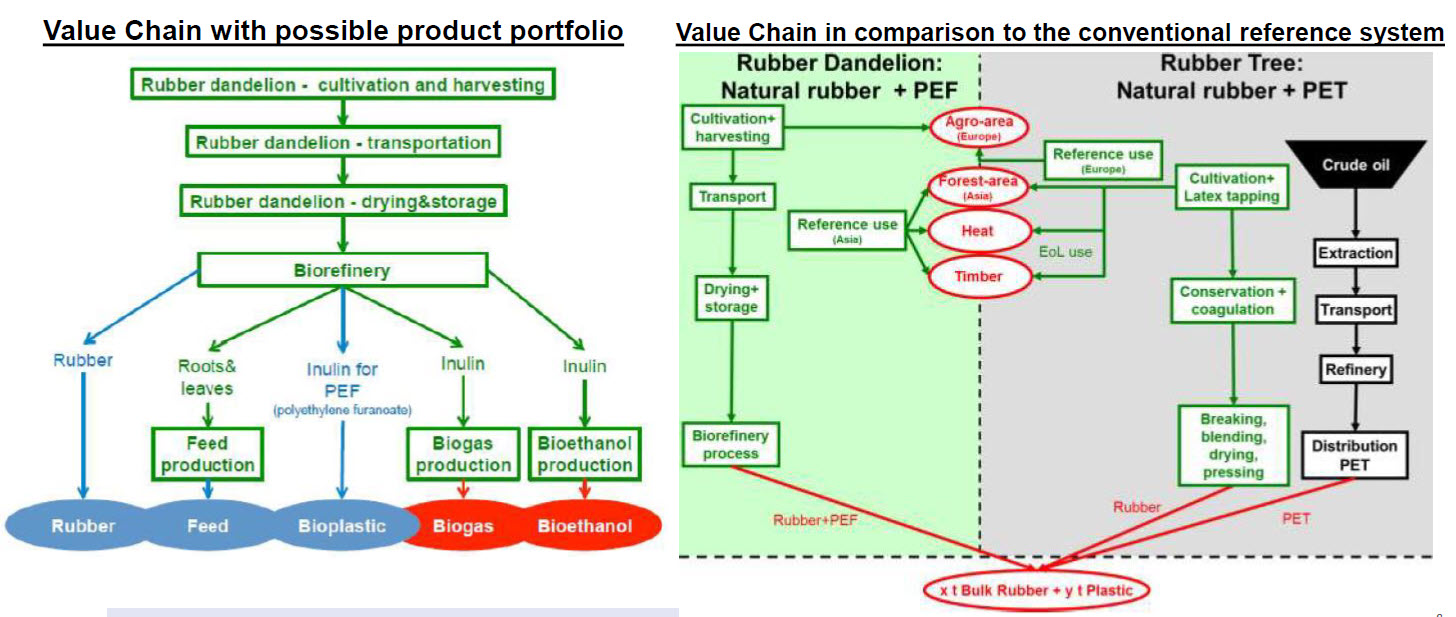
Indoor hydroponic cultivation replaces deforestation-driven rubber tree farming with a controlled, sustainable growing process.
Rubber dandelion is a fast-cycling renewable crop rather than a decades-old tree plantation.
A domestic rubber dandelion industry creates cultivation, processing and biorefinery jobs on U.S. soil.
Domestic production directly reduces U.S. reliance on Southeast Asian rubber imports.
Controlled-environment indoor cultivation replaces the unsafe, inconsistent conditions of traditional latex tapping.
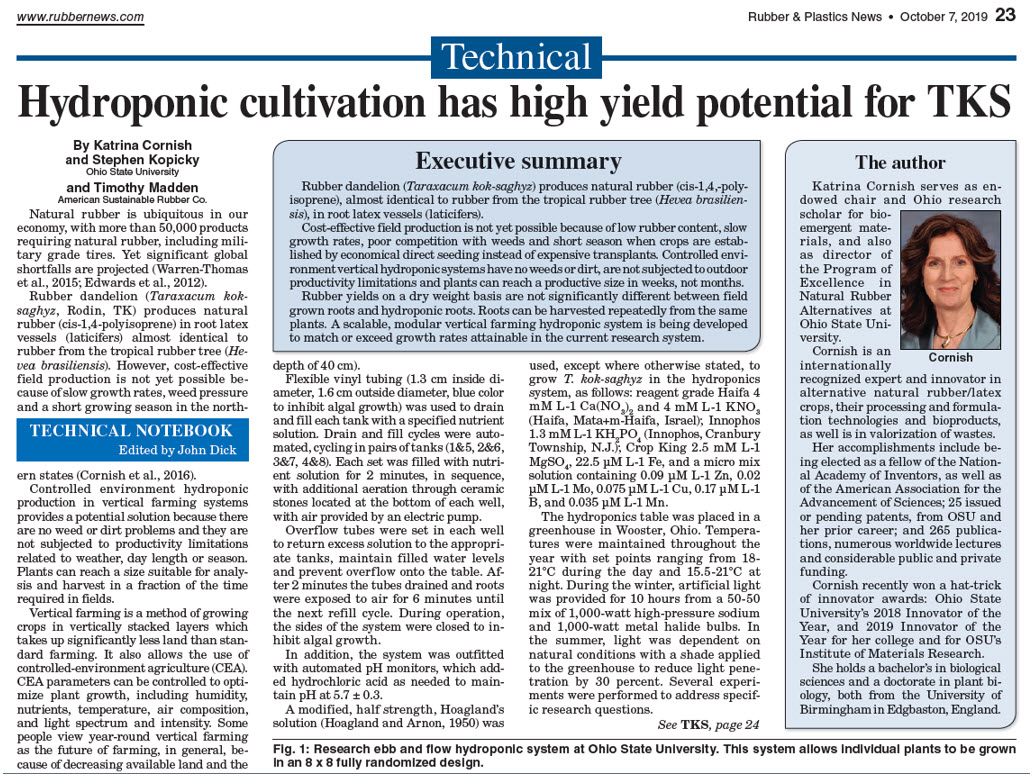
Ohio State University's Katrina Cornish — an endowed chair and director of the university's alternative natural rubber research program — has published on rubber dandelion's high-yield potential in controlled-environment vertical hydroponic systems, in Rubber & Plastics News.
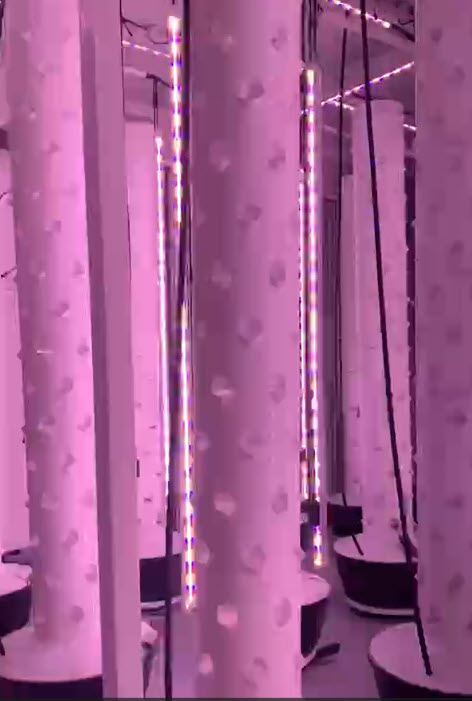
A GTG 4-meter vertical hydroponic tower with illumination system — the kind of controlled-environment infrastructure used to grow rubber dandelion at scale, indoors, independent of field conditions or growing season.
About 850 million pallets are manufactured in the U.S. each year, built primarily from wood, plastic, or rubber. Both incumbent materials have real drawbacks that GTG's composite rubberized pallets are designed to solve.
Wooden pallets splinter and warp under repeated load, and lack the longevity and durability to hold up through a full life-cycle of reuse.
Plastic pallets last longer but are produced through energy-intensive, high-emission processes. Damaged plastic pallets can't be repaired — only replaced with new ones — and recycling them is itself energy-intensive, while disposal adds to non-recyclable solid waste.
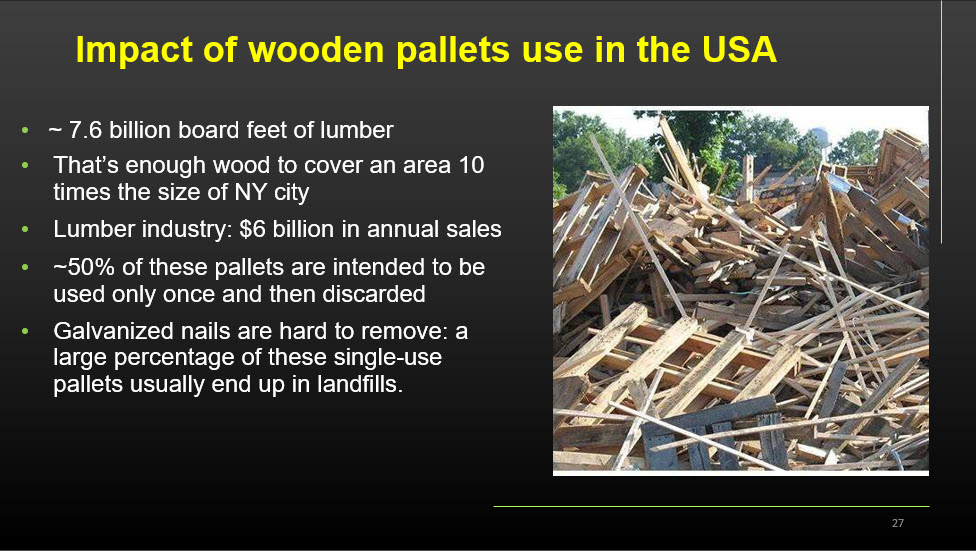
That's enough lumber to cover an area 10 times the size of New York City — a $6 billion annual industry where roughly half of all pallets are used once and discarded. Galvanized nails make them hard to salvage, so most end up in landfills.
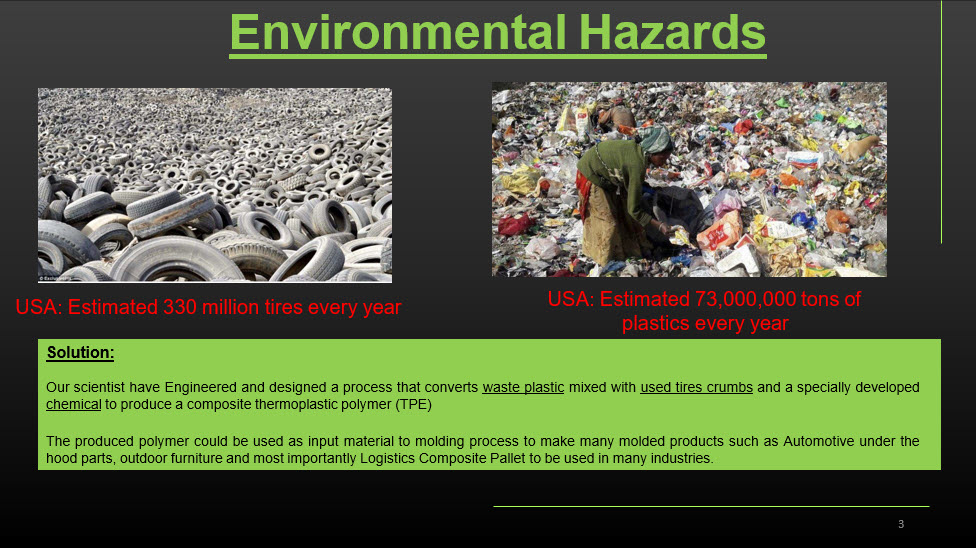
GTG's engineers converted that waste stream into a solution: used tire crumb rubber blended with waste plastic and a proprietary chemical produces a composite thermoplastic elastomer (TPE) — a moldable input material for products like logistics pallets.
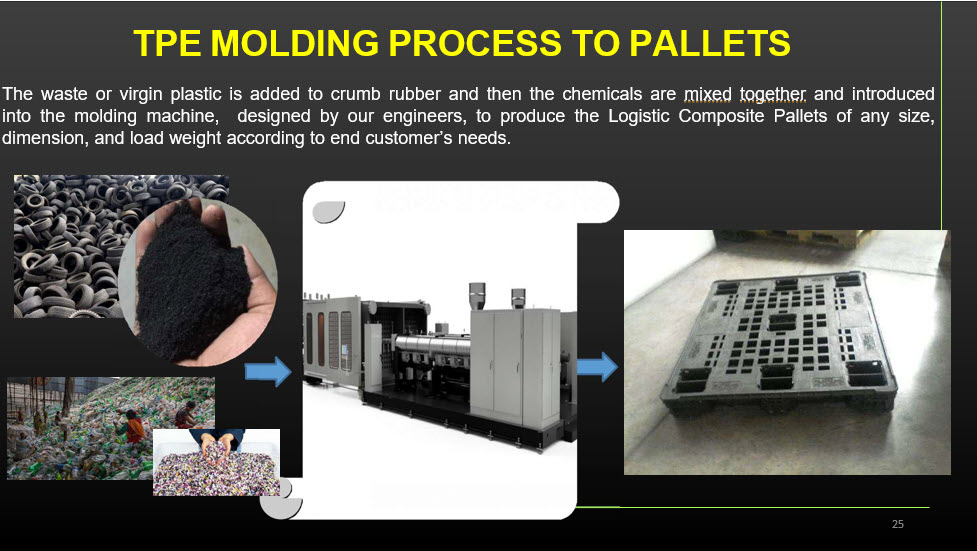
Waste or virgin plastic is blended with crumb rubber and mixed with proprietary chemicals, then run through a purpose-engineered molding machine to produce composite logistics pallets in any size, dimension, or load rating.
Any size, any shape — rackable, nestable, available in various weights and dimensions, surface-treated, and compatible with GPS tracking devices.
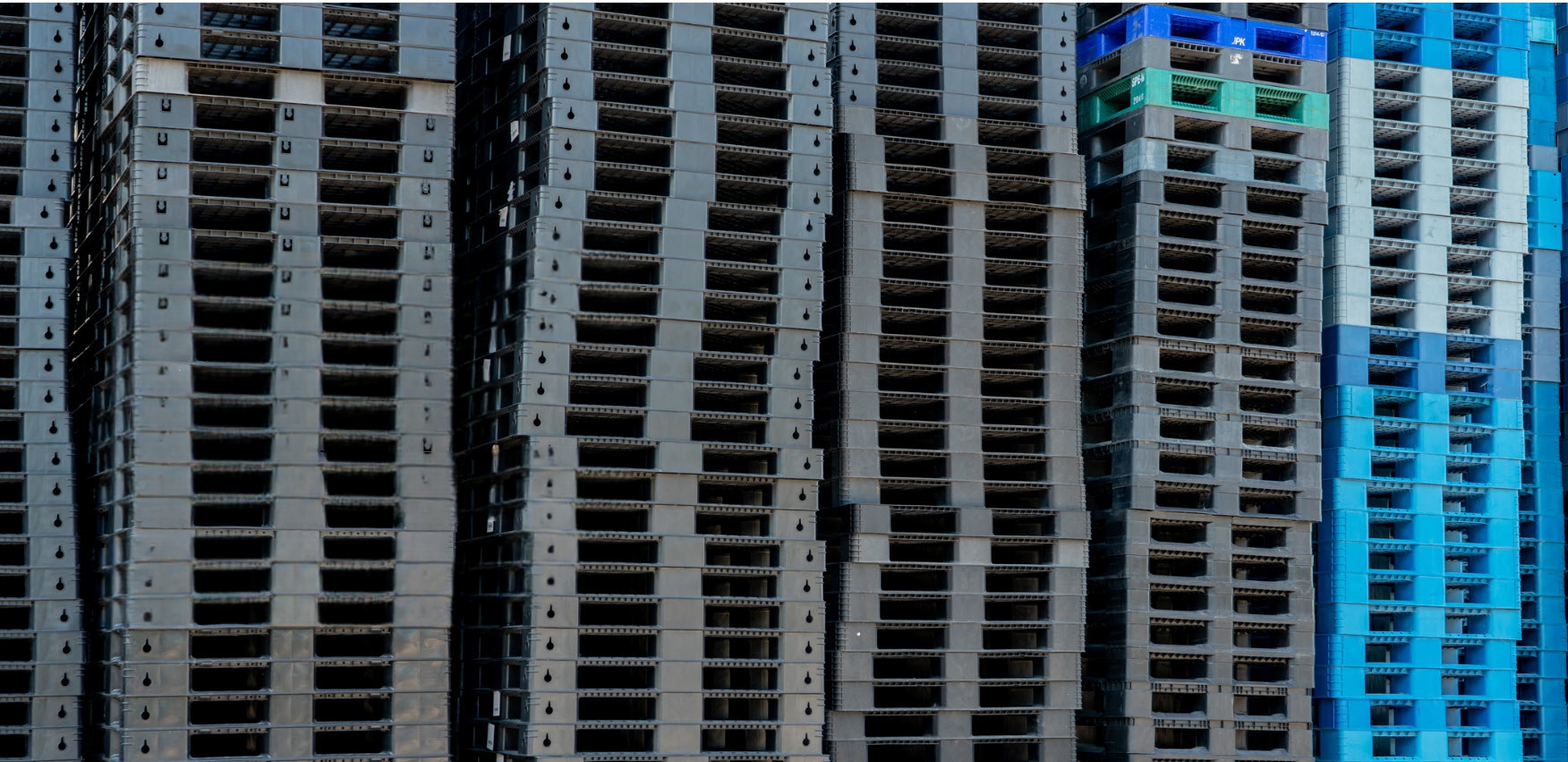
Composite pallets stacked and staged at volume — produced in a range of colors, sizes, and load configurations to match customer specifications before shipment.
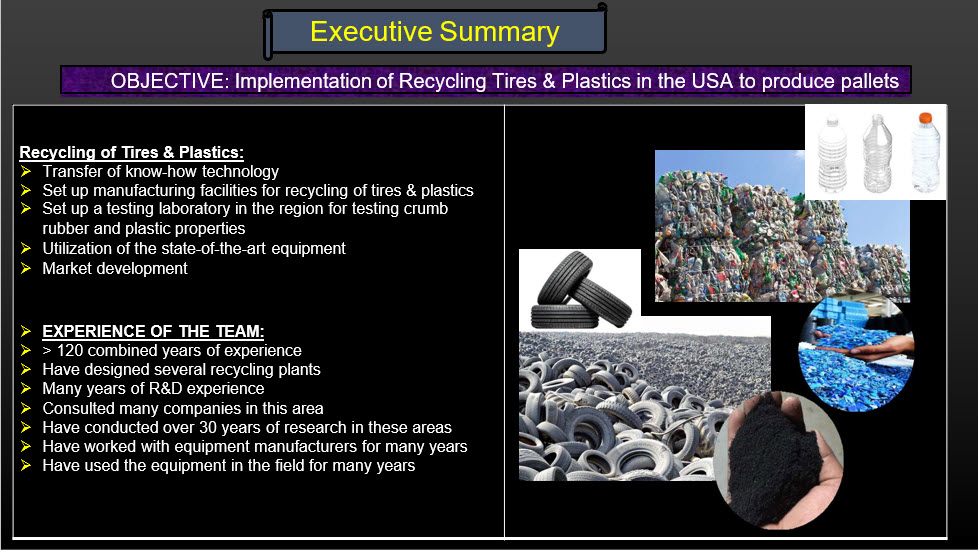
A team with 120+ combined years of experience in recycling plant design, R&D, and equipment operation is behind the technology transfer, manufacturing setup, and testing lab needed to bring it to market.
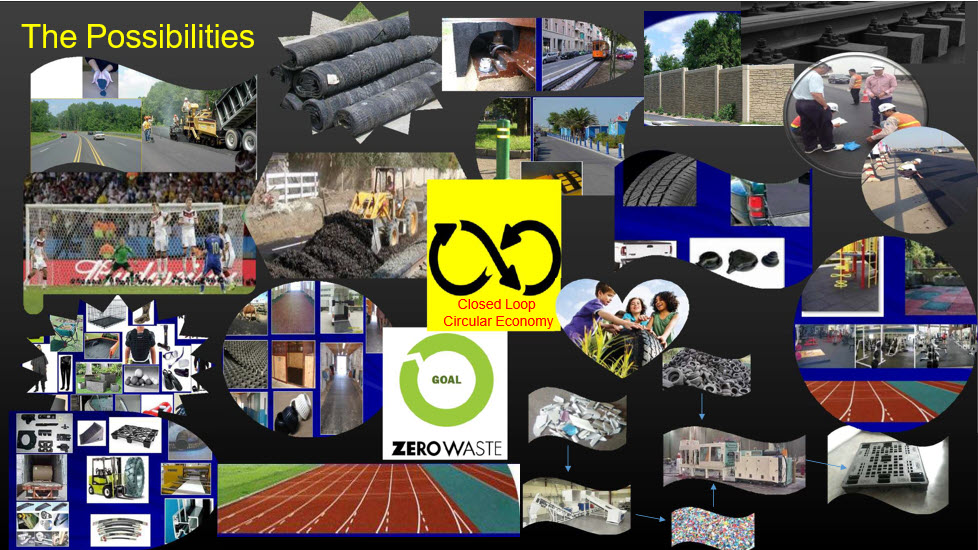
The same recycling process feeds a much wider set of applications beyond pallets — from roadways and sound barriers to sports surfaces, playgrounds, and gym flooring — all in service of a closed-loop, zero-waste economy.
Extreme weather is the Achilles' heel of the U.S. rail network. Of the roughly 700 million wooden railroad ties installed nationwide, 20 million must be replaced every year — an annual expenditure exceeding $1.5 billion. GTG's composite ties, made from 100% recycled waste plastics and tires, are built to change that math.
| Recycled Plastics | ~60–70% |
|---|---|
| Shredded Rubber (scrap tires) | ~25–35% |
| Proprietary Additives | 5–15% |
| Wood Tie Lifespan | ~15 years |
|---|---|
| Composite Tie Lifespan | ~50 years |
| Wood Cost of Ownership | $10 / unit / year |
| Composite Cost of Ownership | Up to $5 / unit / year |
Doesn't absorb moisture, rot, or degrade underwater flooding, and resists the thermal stress that causes sun kinks in summer heat.
Wooden ties are treated with creosote and chromated copper arsenate to resist rot and insects — chemicals that can leach into soil and water. Composite ties carry no such treatment.
Low electrical conductivity and non-combustible construction, with better lateral stability than wood for high heat and heavy loads.
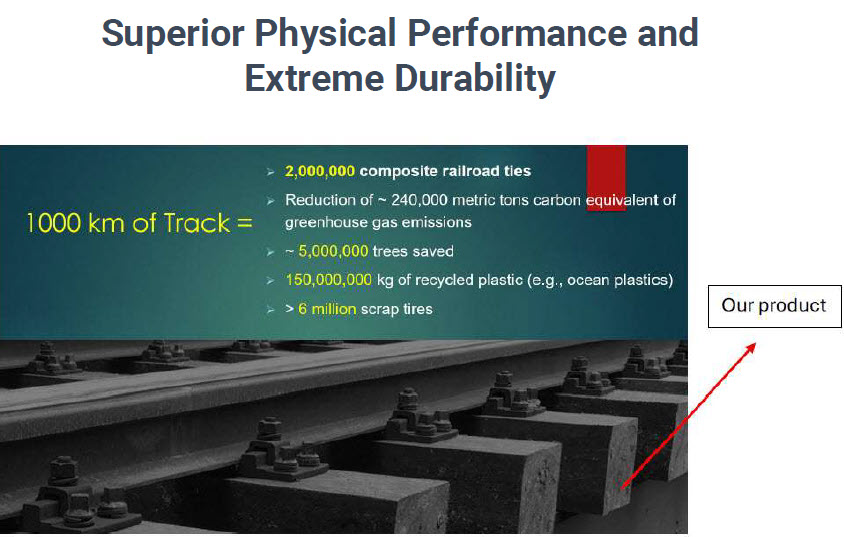
Every 1,000 km of track laid with GTG's composite ties represents roughly 2,000,000 ties, ~240,000 metric tons of avoided greenhouse gas emissions, ~5,000,000 trees saved, 150,000,000 kg of recycled plastic (including ocean plastics) repurposed, and more than 6 million scrap tires diverted from landfill.
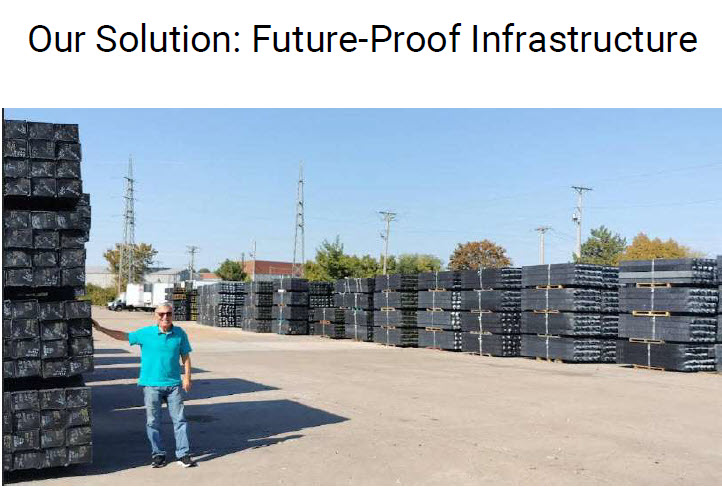
Composite ties staged and ready for shipment — produced at volume from recycled plastics and scrap tire rubber to supply rail infrastructure projects at scale.
Scrap tires that end up in landfills or illegal dump sites pose fire risk, leach chemicals, and provide breeding grounds for pests. Repurposing that rubber into pavement, pallets, railroad ties, and other durable goods converts a liability into infrastructure.
 Green Technology Global